

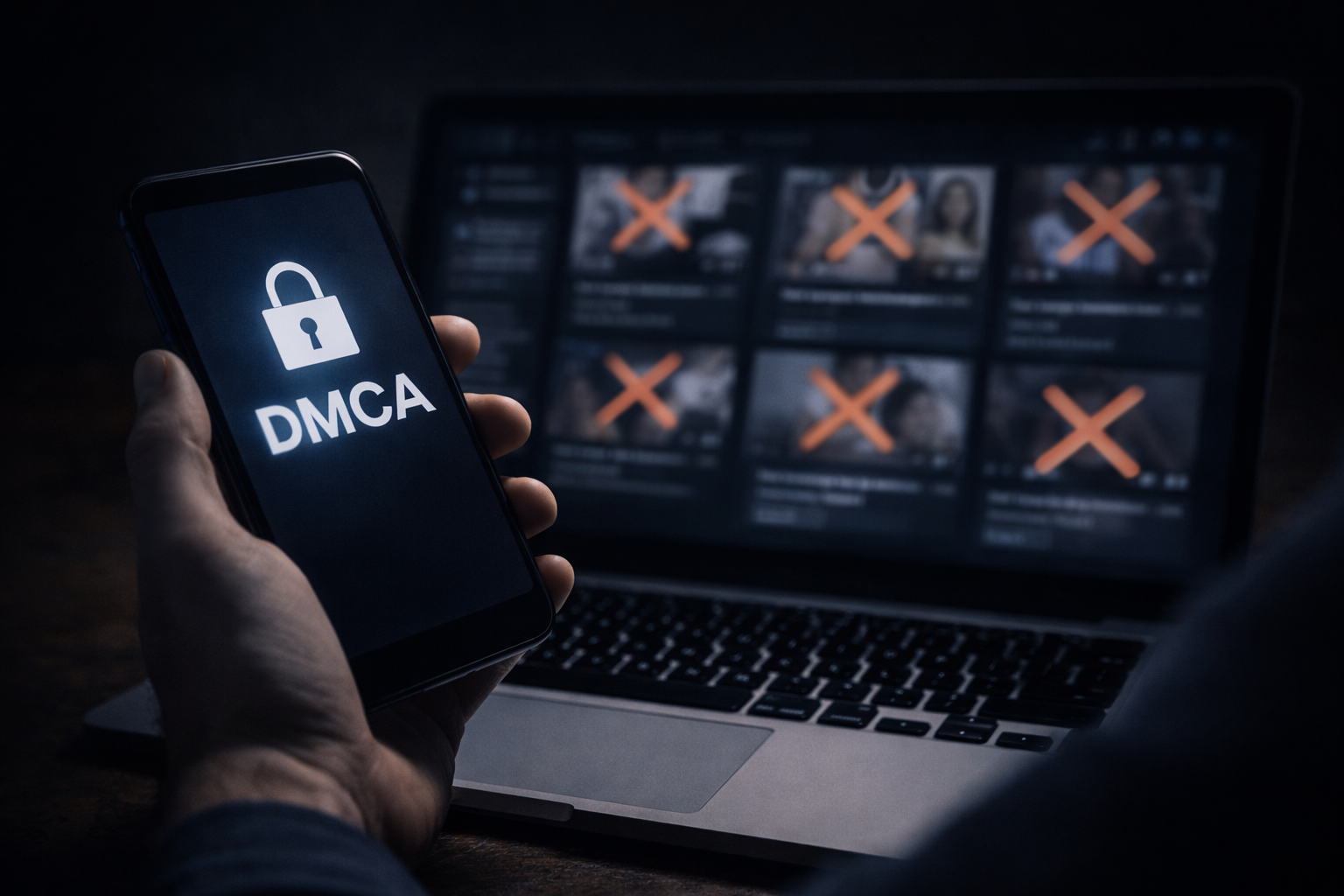
The best DMCA service for a content creator goes far beyond simply deleting a stolen photo. It is a comprehensive system that consistently identifies, removes, and monitors leaked content at scale. Today, ongoing control over your digital distribution is not just a legal necessity; it is a revenue strategy. When you successfully eliminate unauthorized access points, you push high-intent audiences toward a direct conversion on your primary paid platforms.
However, content management requires systems that protect revenue across multiple creator portfolios, rather than relying on manual processes that only address isolated cases.
Why Creator Agencies Need More Than Basic DMCA Takedowns
Most managers start thinking about DMCA takedowns only when they spot exclusive content circulating outside of gated platforms like OnlyFans or Fansly.
The initial reaction is usually simple: submit a takedown request and move on. While this reactive approach works at a very small scale, it shatters as soon as agencies begin managing multiple creators simultaneously.
Your content does not exist in a vacuum. Once leaked, it spreads rapidly across:
- Aggregation sites and forums (such as SimpCity)
- Peer-to-peer file-sharing environments
- Reuploads across a sprawling network of offshore domains
A single takedown notice does not solve the root problem; it merely addresses one instance of a much larger, systemic issue.
What a Premium DMCA Service Actually Does
At its core, a DMCA service is responsible for removing unauthorized, copyrighted material from external platforms. A basic service handles the bare minimum: identifying infringing content, submitting legal takedown notices, and following up on those removals.
However, not all intellectual property protection operates at the same level. The true differentiator is how a service handles scale and repetition.
Basic DMCA Services:
- Highly reactive and manual.
- Focused entirely on individual links.
- Heavily dependent on you or your team finding the stolen content first.
Structured Content Removal Systems:
- Provide ongoing, automated monitoring.
- Feature scalable detection algorithms.
- Execute continuous removal processes.
These advanced systems treat content leakage as an ongoing, persistent threat rather than a one-time event. For growing agencies, understanding this distinction is critical to protecting their bottom line.
The Commercial Cost of Choosing the Wrong Service
Choosing an inadequate DMCA service creates hidden, compounding costs that directly hurt your profit margins.
- Incomplete Removals: If only some of the stolen content is removed, users can still find free access points. This fundamentally weakens your overall monetization strategy.
- Slow Response Times: Every hour of delay allows leaked content to spread further, exponentially increasing unauthorized exposure.
- Lack of Scalability: As agencies onboard more talent, manual tracking processes become a massive bottleneck.
- No Ongoing Monitoring: Content frequently reappears on different domains shortly after a removal, forcing you to restart the entire cycle manually.
These systemic vulnerabilities dilute the effectiveness of your entire revenue model. Even the strongest customer acquisition strategies will underperform if your premium content is easily accessible outside of your paid channels.
Platform Protection vs. External DMCA Services
Platforms like OnlyFans and Fansly offer excellent internal protection. Inside their walled gardens, your content is gated, access is strictly controlled, and payments are securely enforced.
Outside the platform, however, the landscape changes. Content can be screen-recorded, copied, and distributed uncontrollably, resulting in lost revenue. Internal platform security simply does not manage external distribution. This is exactly where professional DMCA services operate.
Sites like SimpCity and other aggregation platforms are specifically structured to collect and distribute scraped content. They amplify the visibility of leaks, making it easier for users to bypass paywalls. This creates an absolute necessity for aggressive, continuous removal.
What the Best DMCA Service Looks Like for Agencies
For creator agencies, the best solution is not defined merely by the volume of takedown notices sent. It is defined by control.
A robust, enterprise-level system should provide:
- Continuous Monitoring: Total visibility into where your assets are appearing across the web.
- Scalable Removal: The ability to handle vast portfolios of creators without adding administrative bloat.
- Fast Response Cycles: Rapid execution to mitigate the spread and impact of piracy.
- Comprehensive Coverage: Scanning capabilities that catch smaller, fragmented sources, not just the major aggregators.
- Consistency: A relentless, ongoing approach to brand protection.
Practical Use Case: Moving From Manual to Structured Removal
Consider an agency managing several high-earning creators. They initially rely on manual DMCA submissions: searching for leaks, filing requests, and tracking responses via spreadsheets. Initial results seem positive, but soon, new links appear faster than they can be removed. Coverage becomes highly inconsistent, and subscriber growth stagnates.
Upon transitioning to a structured removal system, the landscape shifts. Content is identified across a wider array of sources, removals happen continuously, and reuploads are instantly flagged. The result is not just a cleaner digital footprint—it is a stabilized, predictable revenue stream.
Where Remove.Tech Fits Into Your Strategy
Remove.Tech operates as a sophisticated content control system rather than a rudimentary DMCA tool. It is engineered to detect where assets are distributed outside intended channels, remove unauthorized media across diverse environments, and maintain ongoing visibility.
For agencies, this completely changes the paradigm of copyright protection. Instead of playing whack-a-mole with individual leaks, you are actively managing digital distribution. When free access is consistently eliminated, you force the market's hand, ensuring that your monetization efforts align with actual audience demand. Remove.Tech bridges the gap that platform paywalls cannot cover, ensuring your premium content remains exclusive.
Frequently Asked Questions (FAQ)
What is the difference between a basic DMCA service and comprehensive content protection? A standard DMCA service focuses on deleting specific instances of unauthorized content as they are reported. Comprehensive content protection is a broader strategy that includes automated monitoring, proactive detection, and continuous removal, safeguarding the full lifecycle of your intellectual property.
Can agencies manage DMCA takedowns internally? You can manage takedowns manually on a very small scale. However, as your roster grows, the process becomes incredibly time-intensive. Manual approaches rely on human discovery, leaving massive blind spots.
How quickly should leaked content be addressed? Immediacy is vital. The faster content is removed, the less it spreads. Quick responses drastically reduce the number of users viewing your content for free, protecting your brand's exclusivity and value.
Does removing leaked content actually increase revenue? Absolutely. Removing unauthorized access points restores the necessary friction between your content and the consumer. When fans cannot find the material for free, they are funneled back to your official profiles, directly supporting stronger subscriber conversion and retention.
Final Thoughts
The ultimate DMCA service is not the one that merely boasts the highest number of deleted links; it is the one that gives you absolute control over your digital footprint. If your assets continue to circulate freely, your revenue systems will inevitably weaken. By treating content removal as an ongoing, automated operation rather than a one-off chore, your business becomes significantly more resilient, allowing your growth strategies to yield consistent, compounding results.